First published in The Star on 11th November, 2016
Sherman Alexie, the author of the hilarious and heart-wrenching award-winning young adult fiction novel The Absolutely True Diary Of A Part-Time Indian, has published his first picture book.
Illustrated by Yuyi Morales, Thunder Boy Jr tells the story of a young boy struggling to come to terms with his name. Thunder Boy has been named after his dad who is known as “Big Thunder”. Unfortunately, this makes the little boy “Little Thunder”, a nickname that he thinks sounds like a “burp or a fart”.Read More »
When I first heard about this book (several years ago), I was interested to read it in order to understand the minds and the circumstances of those who choose to attempt to cheat total strangers.
I’ve never believed it to be a straightforward issue, i.e. that scammers are all evil bastards who deserve to burn in hell. I think people do things for reasons that only they can fully comprehend. Every single day, we all do a variety of things, make decisions, and react in ways that apply only to us as individuals – because each of us has different experiences and even if the experience is identical, two people will not react to it in exactly the same way. Walk a mile or two in soneone’s shoes before you judge their actions – that’s what I try to do (not always successfully).
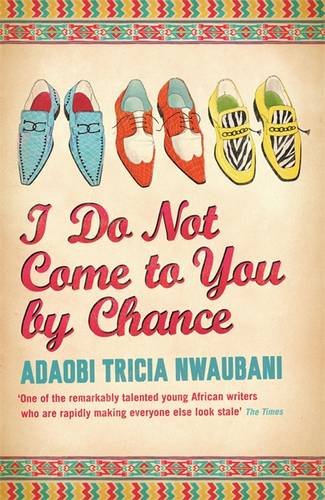
I was added by a few scammers on Skype very recently (see this blog post for more on that) and the experience of dealing with them (I responded because I was curious about how they operate), led me to finally read I Do Not Come to You By Chance.Read More »
I’m planning to move to Lagos in Nigeria sometime in the next year, and while I’ve read several works of fiction which have Lagos as a setting or partial-setting, I thought I would try to find some travelogues (the sort of travel lit written by the likes of Paul Theroux and Colin Thubron) about Nigeria/Lagos.
Sadly, there doesn’t seem to be much out there in terms of modern (preferably 21st century) non-academic non-fiction. This list from The Guardian features five works of fiction (one of them set largely in New York city); a disdainful essay by Chinua Achebe; an account of the Biafran war, written by a British journalist; a personal memoir-cum-history of the country by another British journalist; Nigerian author and playwright, and Nobel laureate Wole Soyinka’s memoir; and only one travel book, by the daughter of the late Nigerian author and eco-activist (executed for his activism) Ken Saro-Wiwa.Read More »
When I finished reading this book, I wanted to read it all over again. I felt it opened a window wide and I couldn’t get enough of the scene it framed. I wanted to go back and pick over everything slowly, paying more attention to each detail, thinking about each situation, analysing each character.
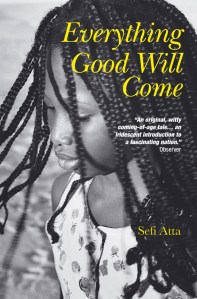
I am planning to move to Lagos, where Sefi Atta‘s Everything Good Will Come is set. Sure, the book opens in 1971, one year after the end of the Biafran war, and ends in 1995. A lot has changed, since then. Or has it? In any case, I don’t think people change much. Skyscrapers may rise and roads may be built, but the old attitudes remain, by and large unexamined and unchallenged. This may sound pessimistic of me, but let’s just say that I don’t want to expect too much. I tell myself I should be prepared for sexism, corruption and hypocrisy. It’s very much present in the world anyway, and from what I have heard and read, rife in Nigeria. I should remember that Don (my fiance) is an exception, and not the rule.Read More »
I finally read Lynne Rae Perkins’s All Alone in the Universe, which I only managed to find this year, at Kinokuniya.
I read Criss Cross several years ago and if it’s possible for a writer to be one of your favourites based on just one book then Lynne Rae Perkins is that author.
I might have known, one-upon-a-time, that All Alone has the same protagonist as Criss Cross, but I’d forgotten. In fact, I’ve forgotten what Criss Cross is about, just that I loved every word of it.
All Alone comes before Criss Cross and it’s a short book that left me wanting more. Indeed, it could be one of Alice Munro’s longer shorties, and as beautifully and evocatively written. Debbie, the main character, is well-realised, and I completely related to her and her struggles.
It may sound crazy that I, at 49, totally gets the feeling of loss, indignation and isolation a 14-year-old feels when she senses her friend drifting away from her, but there you go. Not only do I remember feeling those emotions when I was Debbie’s age; I still feel them now, and then also feel petulant and spoilt when I do.
Books in which ‘not a lot happens’ are my favourite sort, and this story is one of those: not action-driven, but flowing with the meandering currents of Debbie’s state of mind and emotions.
Combined with art by Perkins (it was her major as an undergraduate as well as in grad school), the overall impression is both whimsical and contemplative.
All Alone‘s only fault, in my opinion, is that it’s too brief and thus, somewhat lacks a sense of resolution. Of course, this (resolution) is not a must: Life doesn’t always (hardly ever, actually) resolve neatly in a concluding chapter and paragraph, and Debbie is obviously a work-in-progress.
I’ve started reading Cixin Liu’s The Three-Body Problem (continuing my Oct to Dec TBR challenge), but I think I shall make a short detour to Criss Cross.
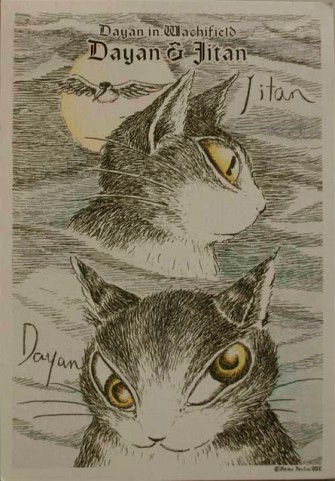
I LOVE cats, but even if you’re not partial to flesh-blood-and-fur felines, you may find it hard to resist the charms of Dayan.
He is the creation of Japanese author/illustrator Akiko Ikeda and is the main character in four books translated and published by Dark Horse (best known as a publisher of comics). If you look at Ikeda’s website (www.wachifield.com) it seems that there are more books, including picture books and novels, featuring the cat and his friends. However, they’re in Japanese. The four titles thus far available in English are a little larger than Ladybird books, with the same hard covers, and fully-illustrated with the most charming and interesting watercolours.
Dayan has grey and red-gold stripes, a white stomach and four white feet. He has huge slanted amber eyes – and in fact, Ikeda’s characters are all notable for their large lustrous eyes.
Dayan lives in Wachifield, an imaginary world dominated by woodland and streams, and populated by the usual forest creatures like rabbits, frogs, foxes, otters and squirrels. There is an alligator though – his rather incongruous presence isn’t explained, and that’s one of the things I like about the way Ikeda writes. She doesn’t overtell the story – there’s no exposition at all, and characters and events appear in the books without introduction, but as if Ikeda is telling stories of creatures the reader already knows well. If you want every detail provided for you, then you may not like Ikeda’s style, but I find it very fresh and light. The reader is free to be a co-creator with Ikeda – he may suppose and imagine whatever he wishes when contemplating the world of Wachifield.
Inspired by this Guardian blog post, I chose Fire and Hemlock as my third Diana Wynne Jones re-read.
This story is a Tam Lin re-telling, and although I am interested in the ballad and interpretations of it, and this book is one of my favourite DWJs, I’ve always felt uncomfortable about the relationship between Polly (Jones’s Janet) and Thomas Lynn.
OK, if you haven’t read Fire and Hemlock, there will be spoilers in this post, so click the Read More button at your own risk.Read More »
My re-read of Diana Wynne Jones IS continuing, I swear, although it keeps getting interrupted by me being in the mood for other books (currently, Qiu Xialong’s Chief Inspector Chen mysteries). After a hugely satisfying Hexwood re-read, I started on the Unexpected Magic anthology, abandoned that and moved on to The Time of the Ghost.
The Time of the Ghost was my very first DWJ, bought in 1986, in Singapore when I was doing my ‘A ‘levels at National Junior College. I seem to remember a table with books laid out on it, at some kind of market or near a hawker centre. I think it was in Jurong West, where I stayed in a rented room. I still have the book I bought (above), a hardback Macmillan edition, with cover art by Maggie Heslop.Read More »
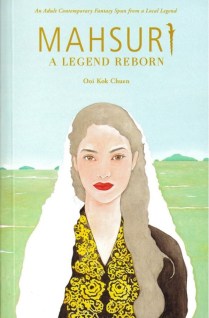
IN Mahsuri: A Legend Reborn, Ooi Kok Chuen expands on the legend of Langkawi’s famous icon who was supposed to have cursed the island during her execution for adultery. My ex-husband, whom I met in Langkawi 20 years ago, says that the curse actually involves anyone who visits Langkawi being doomed to listen to Mahsuri’s story being repeated, ad nauseum, by all and sundry. I have to agree that it really gets milked to death and would benefit from some skilful re-telling.
Preeta Samarasan, the author of Evening is the Whole Day, actually wrote a compelling version of the tale for my collection Malaysian Tales: Retold and Remixed, but I feel the story, like this region’s other fairytales, myths and legends, offers Malaysian writers endless scope for fresh interpretations, and its potential has not been maximised.
Such stories have usually survived generations stripped down to the barest, most basic of plots, their key players little more than cardboard figures just crying out to be fleshed out and reimagined. Read More »
This is the first in a series of posts about my re-reading of selected Diana Wynne Jones stories. I will not be reading them in order of publication, but purely according to what I feel like next. I will also not be reading every DWJ book I own (thirty seven in all).
Cover of my second copy of Hexwood. I can’t seem to find the image of my first copy’s cover, which makes me wonder if I’m remembering it wrong.
My first DWJ re-read is Hexwood. I read my third copy of the novel. I left my first (paperback) copy on a chair in Amsterdam airport’s departure area while waiting for my connecting flight to Koln. My second copy (also a paperback) was lost somewhere in KL or PJ — I think it may have been in a post office or similar. The copy I have now is a hardback, ex-library edition, published by Methuen in 1993. I was living in England when Hexwood was first published, but I wasn’t aware of it. At that point I had only read The Time of the Ghost, which I had picked up at a flea market in Singapore. I do remember looking for DWJ’s books while living in England, but not finding any. Odd.