Book Review: Popville, In the Forest, and Under the Ocean by Anouck Boisrobert and Louis Rigaud

First published on 14th July, 2013 in The Star

popville

I THINK it’s come to the point where 3D versions of movies are being produced just because. It’s like a matter of course, just like filming in colour. I don’t get it though. I mean, 3D effects are not necessary for all movies. I can understand why a superhero/action film might benefit from being 3D (Spider-Man leaping into your lap is, I believe, the sole content of some people’s sexual fantasies), but The Great Gatsby? Really? I fail to see the point, and I don’t intend to find out whether there’s one. (I wait, with dread, for a 3D Casablanca.)

Anyway, what I think about 3D movies is what I’ve recently started to think about pop-up books … which are, really, 3D books, or books with 3D illustrations. Suddenly, it’s like every title needs to pop, and, because of the very nature of pop-up books (their production is time-consuming and labour-intensive), the pop-ups are the main event, not the story – at least not when classics are turned into paper art. There’s no way the unabridged The Wizard of Oz could be made into a pop-up book (imagine the price tag!). Instead, massively abridged versions of these books are produced. Sometimes, only key scenes make it into the book as is the case with Robert Sabuda’s The Chronicles of Narnia.Read More »
Book Review: Ten Things I’ve Learnt About Love by Sarah Butler

10 ThingsFirst published on 30th June, 2013 in The Sunday Star

TEN THINGS I’VE LEARNT ABOUT LOVE

Author: Sarah Butler

Publisher: Picador

THE TITLE of this book is unfortunately reminiscent of that teen rom-com 10 Things I Hate About You. It’s also misleading … or perhaps the fact that I was misled just shows that I am a romantic and sentimental fool, immediately thinking the title referred to the love between a man and woman. It doesn’t, and there are no love-lorn, star-crossed teenage lovers in it … thank goodness.Read More »

Book Reviews: Thursday’s Children & Listen to the Nightingale by Rumer Godden

First published on 26th May, 2013 in The Star

THIS week, two ballet novels by Rumer Godden. Thursday’s Children and Listen to the Nightingalewere out of print, but are two of the 15 titles that Virago Books has acquired for its Modern Classics list.

I’m not sure if girls still love reading ballet stories. A couple of years ago, I had a conversation with a group of young ballet students in a local dance school and was dismayed to find that none of them had heard of Noel Streatfeild’s classic Ballet Shoes. They liked reading but they didn’t read ballet stories. I suppose it was presumptuous of me to assume that just because they danced, they would like to read about dancing. Perhaps only those of us who love ballet but don’t actually dance need to live vicariously through the characters in ballet books.Read More »

Book Review: KL Noir Red

KL NOIR REDFirst published on 14th April, 2013 in The Star
KL NOIR: RED

Editor: Amir Muhammad

Publisher: Fixi Novo

FIXI NOVO is the English language imprint of Amir Muhammad’s hugely successful Buku Fixi. Actually, I lie: according to the description on Fixi Novo’s Facebook page, the imprint publishes books in the American language, while its Manifesto declares that American spelling is used because “we are more influenced by Hollywood than the House of Windsor”. Fair enough, not that the distinction hits you like a ton of bricks or anything: Malaysians seem to use American and British spelling interchangeably and, if we’re talking terminology, most of us are, I believe, equally comfortable with bonnet and hood, lift and elevator, biscuit and cookie, and so on … and probably wouldn’t even be able to identify which term is American and which British.

The point is to position Fixi Novo as an unabashedly non-literary imprint (“pulp fiction”) that’s supposed to appeal to the unpretentious, unwashed masses – in particular the “young, the sengkek and the kiam siap” – no italics please!Read More »

Book Review: Vampires in the Lemon Grove by Karen Russell

lemon grovesFirst published on 5th April, 2013 in StarMag
VAMPIRES IN THE LEMON GROVE
Author: Karen Russell
Publisher: Knopf, 243 pages

YOU’D be forgiven for thinking that this book might be another romance featuring an undead geriatric lusting (chastely) after a 16-year-old airhead, but sorry, if that’s what you were hoping for, you really should have known better, from the title, not to mention the bright yellow book jacket.

Vampires in the Lemon Grove is just one story in a collection, and the only one about vampires, although all are as unsettling and uncanny as vampire stories should, but have, recently, ceased to be.Read More »

Book Review: Codename Verity by Elizabeth Wein

Code_Name_VerityFirst published 21st March, 2013 in The Star
Review by DAPHNE LEE

CODE NAME VERITY

Author: Elizabeth Wein

Publisher: Electric Monkey, 451 pages

I USUALLY have to speed-read books I’m reviewing because I’m too busy to savour every sentence. Sometimes this is a blessing because not all books I review are enjoyable reads. (I usually re-read the good ones later, at a more leisurely pace.)

I knew Elizabeth Wein’s Code Name Verity was one of the good ones from its first paragraph, though, and I actually read the first two thirds of the book fairly slowly despite never having been busier in my life. I think, despite it being a rather harrowing read, I decided that it would serve as welcome respite at the end of the day, when I’d given up on all the writing and editing, when I was dead tired and would have knocked back a gin or two if I actually drank, when I was forced to stop working because the mosquitoes were biting despite the heavily-smoking moon tigers and layers of organic repellent covering every inch of exposed skin.

This morning, despite not having to be up early on account of it being the school holidays, I woke up at 7am anyway so I could finish the book and write this review. I’m afraid I rushed through the final third of the book so I could send this column in. I also couldn’t bear any more suspense.

This is one of the many books that I didn’t get around to reading last year and so, did not include in my best of 2012 list. Otherwise, it would certainly have won the top spot. It’s even more glorious than Seraphina, which was my pick for the best of the best of 2012.

Read More »

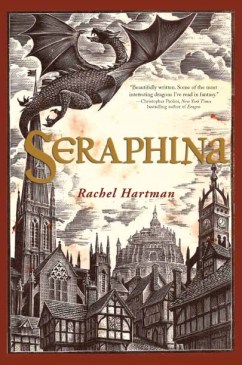
Book Review: Seraphina by Rachel Hartman

R2281efed71369a01d8885ddff2281ebcFirst published on 28 October, 2012 in The Star
Seraphina
Author: Rachel Hartman
Publisher:
Random House Books for Young Readers, 480 pages

THE world is the kingdom of Goredd where, 40 years earlier, a treaty had been signed between man and dragonkind. Since then the communities have coexisted in relative harmony. The dragons are obliged to take human form within the city walls and are forbidden to hoard gold. For younger dragons, knowledge is stored instead, literally, in the form of stacks of books.

Orma is one such dragon. He is a scholar and Seraphina’s music teacher. There is a more complex relationship between the dragon and the book’s main character, but I am going to try to keep this review spoiler-free. I fear this means not saying much about Seraphina herself. She is, naturally, at the centre of much of the action and to reveal too much about her would practically give the plot away. Suffice to say she is the only daughter of a widowed lawyer, the assistant to the court composer, and tutor to the Crown Princess Glisselda.Read More »

Book Review: Garden of Evening Mists by Tan Twan Eng

GardenFirst published on 28th Feb, 2012 in The Star

THE GARDEN OF EVENINNG MISTS

Author: Tan Twan Eng

Publisher: Myrmidon

Review by Daphne Lee

ON a mountain above the clouds once lived a man who had been a gardener of the Emperor of Japan.”

The first sentence of Tan Twan Eng’s second novel, The Garden Of Evening Mists, has a fairytale-like resonance, a magical quality that intrigues and beguiles. Who was this man and why did he journey so far from his home? Where was this mountain above the clouds and what did the Emperor’s gardener do there?

Almost immediately, this sense of picturesque tranquillity is disrupted by vague yet unmistakable references to violence, pain and sorrow in the subsequent sentences.

What was the exact nature of the relationship between the novel’s narrator and the Japanese gardener? From the book’s second paragraph, I found myself utterly absorbed by Tan’s characters, captivated by their histories and, especially by how the paths of their separate lives intersected and finally converged at Yugiri – the garden of evening mists.Read More »

Interview: Bernice Chauly, on ‘Growing Up with Ghosts’

A shorter version of this interview was first published on 22nd November, 2011 in The Star

bcWHAT stands out for me when I think of Bernice Chauly’s book Growing Up with Ghosts – A Memoir, is the story of her father’s death. It is where the book begins and Chauly’s dreamlike and poetic description of how her three-year-old self deals with the sudden loss of a beloved parent is, for me, the most heartbreaking and compelling thing in this book.

Later, when introduced to the young Bernard – the curious, adventurous trainee teacher, the passionate young lover, the idealistic newly wed – it is my initial vision of him as a loving, devoted father that fixes my attention and makes me want to learn more about him.

His death affected Chauly powerfully, but it was just one of many losses her extended family had to endure. Deep in the heart of the book is the family curse that Chauly seeks to understand. Its almost gothic details, including a pilgrimage to India to visit an ancient snake temple, imbue the book with a sense of mystery and deep, devastating horror.

In our interview (conducted via email), Chauly said the real reason for writing the book was to find ‘the root of the curse’, and understand why all the men in her family died. ‘I grew up haunted by grief, and my grief became a ghost, I had to confront it and finally let it go, she said.

She went on to say that she used ‘ghosts’ as a metaphor ‘for many things – for untold histories, for the voices who lived through difficult times, who were never  heard; for things that scare you, and things that come back to haunt you, for the dead whom I mourned, for the dead that my ancestors mourned, the dead who became ghosts, who were forgotten, who never told their stories and who were never heard, and who never got a chance to exorcise their grief.’

Writing the book, Chauly says, was ‘cathartic in every way’, an exorcism of sorts that allowed her to make peace with the ‘ghosts’ and with herself. The author uses the voices of her grandparents and her parents to tell a story of struggle and of hardship, of hope and of love. Chauly’s own narrative binds the different voices together and represents the link between the past and the present.Read More »

Interview: Deborah Ahenkorah

Picture

First published on 11th October, 2011 in StarMag

AFRICAN children have something in common with Malaysian children. They have limited choice when it comes to books that reflect their lives. Although the continent has produced many great novelists who have achieved international recognition through their powerful accounts of life in the various African nations they hail from, there are no African children’s authors of similar stature.

Twenty-four-year-old Deborah Ahenkorah, co-founder and executive director of the Golden Baobab Prize, grew up in Ghana reading Nancy Drew, the Famous Five and The Babysitters Club. She says, “I didn’t really realise the absence of African stories in my reading diet until I went to college in the United States on scholarship and I realized that I couldn’t answer any questions on Africa because I didn’t know Africa. I wanted to talk about America and Europe all the time, I knew those places … through my books.”

Read More »