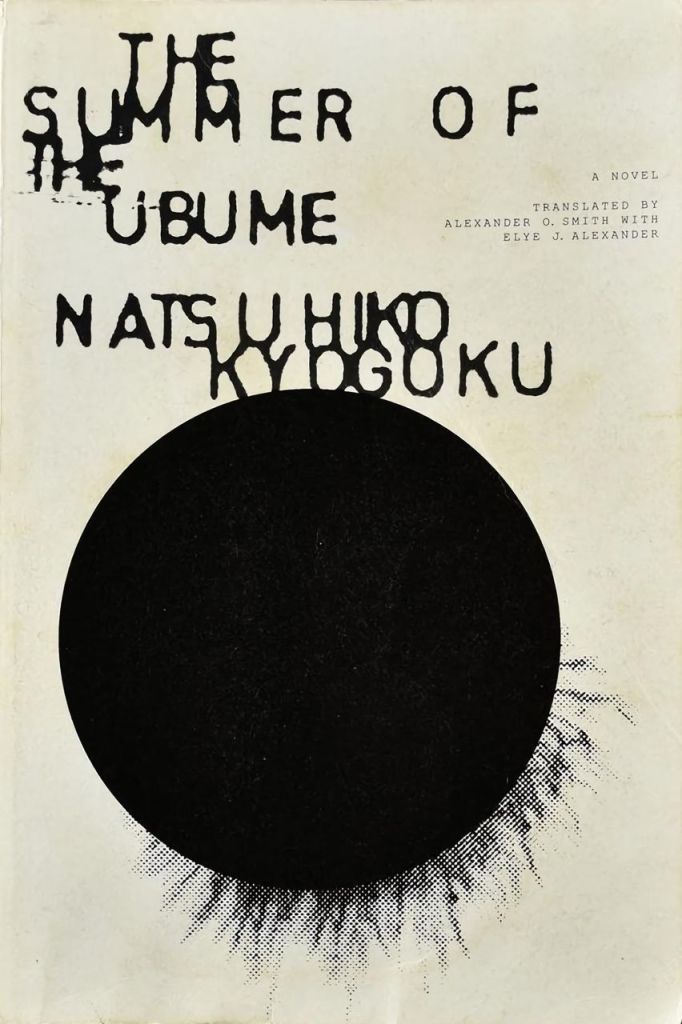
Natsuhiko Kyogoku’s debut novel arrives with a genuinely compelling premise: a woman pregnant for twenty months, a husband who vanished from a locked room, and the shadow of an ancient Japanese spirit—the ubume, a ghost born of a woman who dies in childbirth—hanging over a crumbling clinic in postwar Tokyo. For readers drawn to the intersection of folklore and mystery, this setup promises something atmospheric and unsettling.
The novel’s greatest strength is, frustratingly, the source of its greatest weakness. Kyogoku is clearly a man of enormous intellectual curiosity, and his occult detective Kyogokudo is a vehicle for extended, elaborate meditations on the psychology of belief, the neurology of self-deception, and the philosophical underpinnings of why humans need the supernatural. These passages are not without merit—the central idea that the brain actively rewrites reality to protect itself from unbearable truths is genuinely fascinating, and it pays off in the novel’s twist. But Kyogoku does not trust his reader. He explains, and then he explains again, and then he explains the explanation. By the time the actual mystery accelerates, the narrative momentum has been thoroughly bled dry.
This is a shame, because the core horror is visceral and affecting. The revelation that Ryoko and her supposedly bedridden sister Kyoko are the same fractured person—that the narrator Sekiguchi’s own traumatized mind conspired to hide his complicity in a murder—is the stuff of genuinely great psychological horror. The ubume legend maps onto this tragedy with devastating elegance. A spirit who cannot release her grief, condemned to offer a baby that grows heavier and heavier until it becomes an unbearable stone—it is a perfect metaphor for inherited trauma and collective delusion. One wishes Kyogoku had trusted that metaphor to do its work silently, the way the best folktales do.
Readers familiar with Southeast Asian spirit traditions will find the ubume immediately recognisable in spirit, if not in form. The pontianak of Malay folklore shares this same wounded maternal energy—a woman suspended between worlds, dangerous precisely because her grief is never allowed to rest. Both figures understand something profound: that the most enduring horror is not the monster, but the sorrow that made her. It is worth noting that Kyogoku, to his credit, honours this dimension of the legend. The ubume in his novel is never merely a plot device; she is a genuine emotional truth. It is only the relentless academic scaffolding around her that diminishes the chill.
The climactic exorcism, in which Kyogokudo dismantles the family’s shared delusion in front of everyone assembled, is theatrical and satisfying in structure, even if it arrives exhausted from the journey. The final image—of a lineage ending, of two sisters dying on the same night as different faces of the same broken soul—carries real weight.
The Summer of the Ubume is a novel that contains an excellent, eerie mystery inside a considerably more verbose one. Readers with patience for philosophical digression will find much to admire. Those who come for the ghost story, however, may find that the most haunting thing about the book is how close it comes to being something truly unforgettable.


I do like the sound of this, even with your strictures. Sadly, it seems to be out of print, and Amaz*n UK seems to only offer secondhand paperbacks for silly money. Pity.
LikeLike